 Made in the USA
 ISO certified
 41 years in business
 Excellence in manufacturing
A Complete Guide to Spring Check Valve Operation
A check valve is a one-way valve that allows liquid or gas to flow in one direction while preventing reverse flow. It operates automatically, without a handle, switch, motor, or external control.
In a spring-loaded check valve, pressure from the inlet side pushes against an internal sealing component, often called a poppet. When the pressure is high enough to overcome the spring force, the valve opens and flow begins. When pressure drops, the spring pushes the poppet back into the closed position to stop backflow.
That basic function may sound simple, but check valve operation involves a precise balance of pressure, spring force, flow rate, and sealing performance. Understanding how a check valve works can help improve system reliability, reduce leakage, and support consistent flow in low-pressure, low-flow applications.
This guide explains the fundamentals of check valve operation, the internal parts of a spring-loaded check valve, and the eight stages a valve moves through as it opens, flows, closes, and resets.
What Is a Check Valve?
A check valve is a mechanical valve that controls flow direction. Its main purpose is to allow forward flow while preventing reverse flow, also called backflow.
Unlike a manual valve, a check valve does not need an operator to open or close it. It responds to pressure conditions inside the system. When pressure moves in the intended direction and is strong enough to open the valve, fluid or gas can pass through. When pressure drops or reverses, the valve closes automatically.
Check valves are useful in systems where reverse flow could cause problems such as contamination, equipment damage, pressure loss, or inaccurate fluid delivery.
In low-pressure and low-flow applications, check valves are commonly used in:
- Medical and diagnostic equipment
- Laboratory instruments
- Water treatment systems
- Chemical handling systems
- Beverage dispensing equipment
- Fluid sampling systems
- Dosing and metering equipment
- Small pumps and fluid control assemblies
In these applications, the valve must do more than simply open and close. It must respond consistently at low pressures, seal reliably, and be compatible with the fluid or gas moving through the system.
The Basic Operating Principle
Check valves work because of pressure differences created by fluid or gas flow.
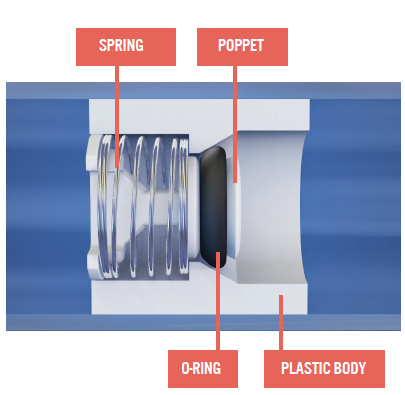
In a spring-loaded check valve, the spring holds the poppet against the valve seat. This keeps the valve closed when there is not enough forward pressure to open it.
The operating cycle can be understood in four basic steps:
- Pressure builds.
Inlet pressure increases on the upstream side of the valve. - The valve opens.
Once inlet pressure overcomes the spring force, the poppet begins to move away from the valve seat. - Fluid flows.
As the poppet opens, liquid or gas moves through the valve in the intended direction. - Pressure drops and the valve closes.
When inlet pressure decreases, the spring pushes the poppet back toward the seat until the valve closes and prevents reverse flow.
Several key concepts are important when discussing the cycle of check valve operation.
Pressure differential is the difference between pressure at the inlet and pressure at the outlet. This difference helps determine whether the valve opens, stays open, or closes.
Spring force is the force applied by the internal spring. It keeps the valve closed until enough inlet pressure is present.
Opening pressure is the pressure needed to begin opening the valve. This is often referred to as cracking pressure.
Reseal pressure is the pressure at which the valve closes again and forms a seal after flow decreases.
Together, these forces control the position of the poppet throughout the valve’s operating cycle.
Understanding the Parts of a Spring Check Valve
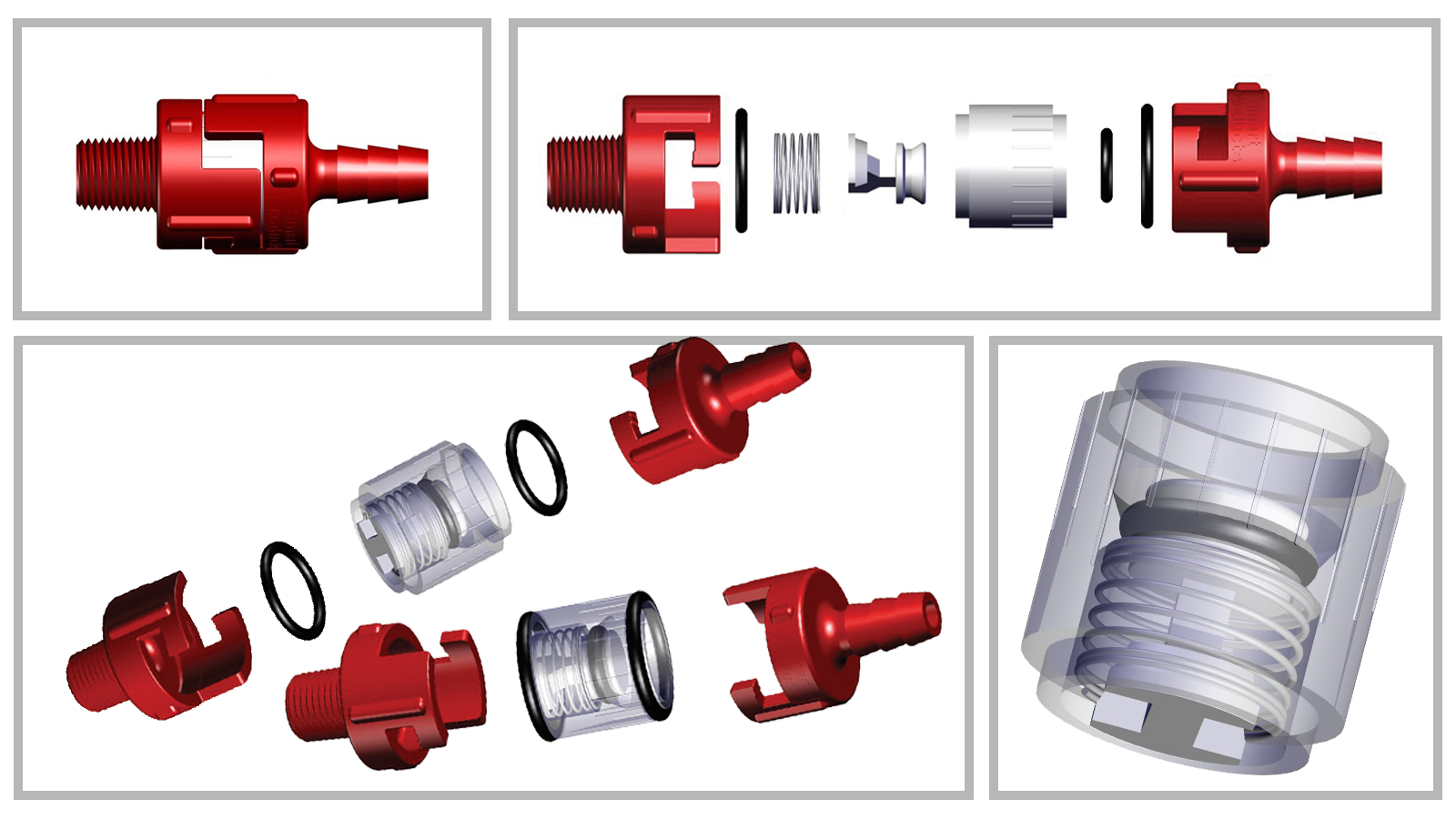
Before looking at check valve operation, it helps to understand the main parts inside a spring-loaded check valve.
Valve Body
The valve body is the main outer structure of the check valve. It houses the internal components and directs flow from the inlet to the outlet.
The body must be compatible with the fluid or gas moving through the valve. It also needs to support the application’s pressure, temperature, and connection requirements.
Poppet
The poppet is the moving component inside the valve. It opens when inlet pressure overcomes the spring force and closes when the spring pushes it back against the valve seat.
The poppet’s movement controls how much flow can pass through the valve.
Spring
The spring provides the closing force. It holds the poppet against the valve seat when the valve is closed and helps return the poppet to the sealed position when pressure drops.
Spring selection has a direct effect on opening pressure and valve response.
Valve Seat
The valve seat is the surface where the poppet seals when the valve is closed.
A consistent seal between the poppet and seat is necessary for backflow prevention.
O-Ring
The O-ring helps create a reliable seal. O-ring material selection is important because different fluids, gases, temperatures, and chemicals can affect sealing performance.
Flow Path
The flow path is the route fluid or gas takes through the valve. The size and shape of this path influence flow rate and pressure drop.
A well-matched flow path helps the valve meet application requirements without creating unnecessary restriction.
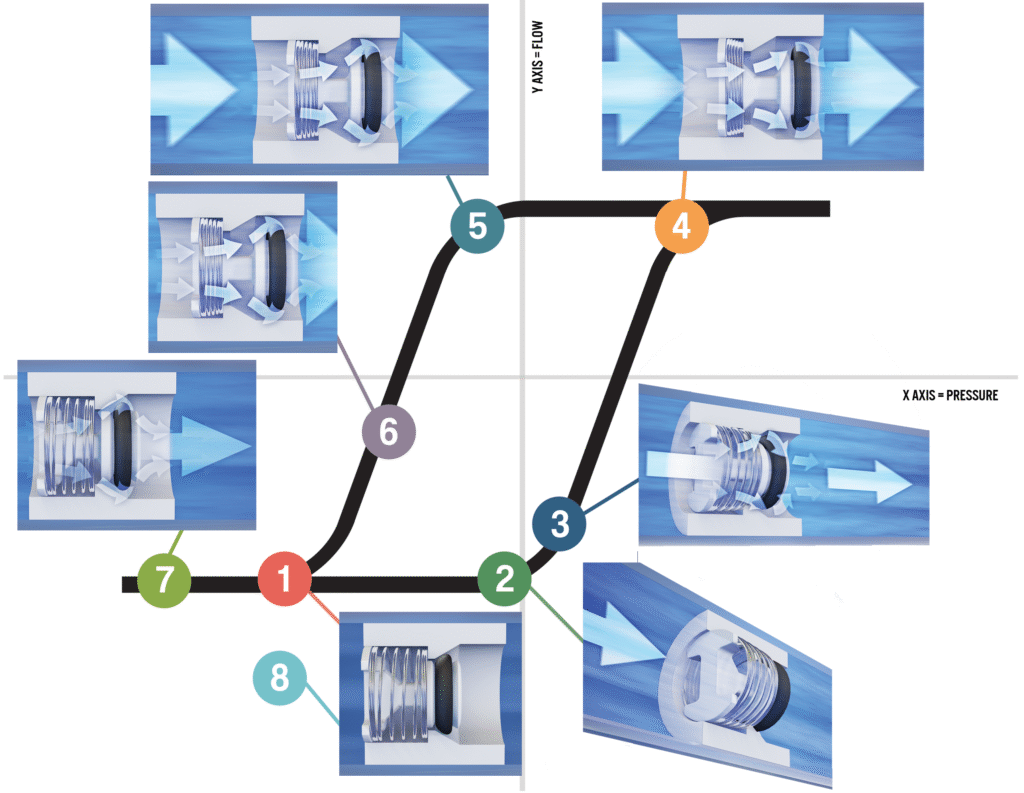
The Eight Stages of Check Valve Operation
A check valve may appear to have only two positions: open and closed. In reality, a spring-loaded check valve moves through several stages as pressure changes.
These stages explain how the valve responds to force balance, spring compression, pressure differential, and poppet movement.
Stage 1: Shut
In the shut stage, the valve is fully closed.
The spring applies preload against the poppet, holding it firmly against the valve seat. There is no forward flow because inlet pressure has not reached the opening pressure needed to move the poppet.
Reverse flow is also prevented because the poppet is seated against the sealing surface.
The valve is closed, sealed, and waiting for enough pressure to open.
This stage is critical for backflow prevention. If the valve does not seal properly in the shut position, reverse flow or leakage may occur.
Stage 2: Opening
The opening stage begins when inlet pressure increases enough to start overcoming the spring force.
At this point, the valve reaches its opening pressure. The poppet starts to lift away from the seat, and a small flow path begins to form.
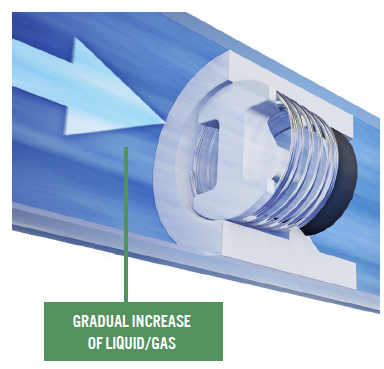
The valve does not instantly move from closed to fully open. Instead, it enters a transition zone. The poppet position changes as the forces acting on it change.
The main forces include:
- Inlet pressure pushing the poppet open
- Spring force pushing the poppet closed
- Outlet pressure resisting forward movement
As these forces shift, the poppet begins to move toward a new balance point.
Many low-pressure applications operate near the valve’s opening pressure. Choosing the right opening pressure helps ensure the valve opens when needed without creating too much restriction.
Stage 3: Open
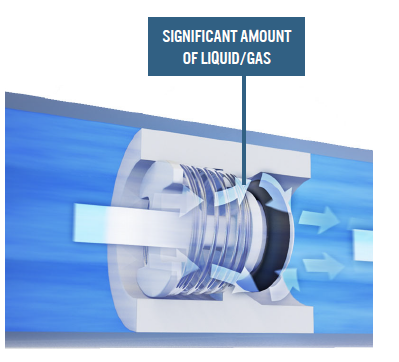
In the open stage, flow has begun and the poppet is lifted from the valve seat.
The valve is no longer sealed, but it may not be fully open yet. The spring is partially compressed, and flow is moving through the valve in the intended direction.
At this stage, the valve is operating in a dynamic balance. Inlet pressure keeps the poppet open, while the spring continues to push back toward the closed position.
If pressure remains steady, the poppet may hold a stable position. If pressure changes, the poppet may move slightly to adjust.
Stable valve opening supports consistent flow. In systems with low flow rates or small pressure changes, the valve may spend time in this partially open condition.
Stage 4: Fully Open
In the fully open stage, the poppet reaches its maximum designed lift.
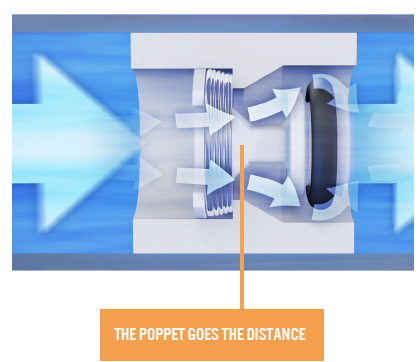
The spring is compressed within its operating range, and the flow path is at or near its largest available opening. This allows the valve to support peak flow for the application.
At this point, there is limited flow restriction compared to the partially open stages.
Proper valve sizing helps ensure the valve can reach the necessary open position for the required flow rate. If the valve is too restrictive, the system may experience higher pressure drop or reduced performance.
Stage 5: Descent
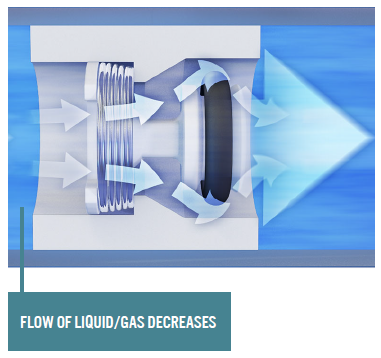
The descent stage begins as inlet pressure decreases.
With less pressure pushing the poppet open, the spring starts expanding and moving the poppet back toward the valve seat. Forward flow begins to decrease.
The poppet does not slam shut under normal operating conditions. Instead, it follows a similarly controlled process as when it’s opening.
Controlled closure helps reduce unstable flow behavior and supports more consistent performance as system pressure changes.
The closing motion depends on how quickly pressure drops, the spring characteristics, and the fluid conditions. In low-flow systems, small pressure changes can affect how quickly the valve begins to close.
Stage 6: Touch Down
During touch down, the poppet approaches the valve seat.
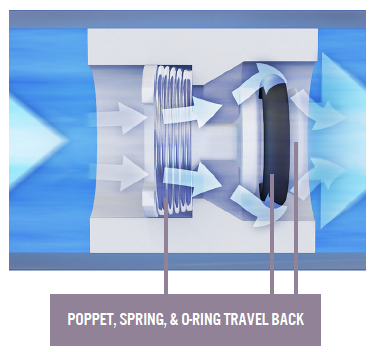
Only a small amount of forward flow may remain. The valve is nearly closed, but the seal is not fully established until the poppet contacts the seat with enough force.
This stage is important because the poppet is transitioning from flow control back to sealing.
Smooth touch down helps support repeatable sealing. It also helps protect the sealing surfaces from unnecessary wear.
The final portion of poppet movement can have a large effect on leak performance. Seat condition, O-ring material, spring force, and fluid properties all influence how the valve reseals.
Stage 7: Resealing
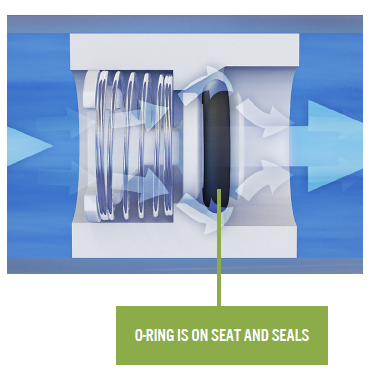
In the resealing stage, the closing forces have fully overcome the remaining opening force, allowing the poppet to seat and restore the seal.
Forward flow stops, and the valve once again prevents reverse flow.
Reseal pressure may not be identical to opening pressure. The valve may begin opening at one pressure and fully reseal at a different pressure as the operating cycle reverses.
Resealing is essential for backflow prevention. A valve that opens properly but does not reseal reliably may allow leakage or reverse flow.
Stage 8: Reset
In the reset stage, the valve has returned to its starting position.
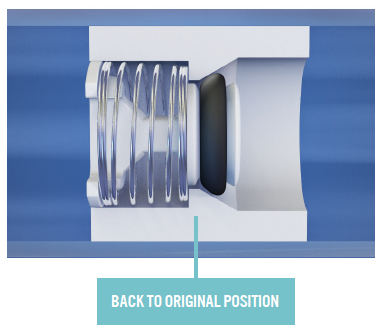
The spring is back to its initial closed position, the poppet is seated, and the valve is ready for the next pressure cycle.
No forward flow occurs until inlet pressure rises again and reaches the opening pressure.
The reset stage allows the valve to repeat the same operating cycle over and over. Consistent reset behavior supports long-term reliability in applications where valves cycle frequently.
Repeatability matters in low-pressure check valve operation. Spring behavior, material condition, and sealing surface integrity all influence how consistently the valve returns to its closed position.
How Pressure Forces Control Valve Motion
A spring-loaded check valve operates through a balance of forces. The position of the poppet is constantly changing based on the relationship between inlet pressure, outlet pressure, and the force applied by the spring.
In simple terms:
- Inlet pressure pushes the poppet open.
- Spring force pushes the poppet closed.
- Outlet pressure can resist opening or assist closing, depending on system conditions.
When the opening force is less than closing force, the valve remains shut.
When opening force becomes greater than closing force, the poppet lifts and the valve begins to open.
When the forces balance, the poppet may hold a stable position.
When inlet pressure drops, spring force moves the poppet back toward the seat.
Because these forces change continuously during operation, the poppet is constantly responding to changing system conditions. Rather than behaving like an on/off switch, the valve moves through a series of positions as pressure increases and decreases.
This is also why valve selection should consider real operating conditions, not just a single pressure rating. Flow rate, pressure differential, spring selection, and media characteristics all influence valve motion.
Understanding Opening Pressure
Opening pressure is the amount of inlet pressure required to begin opening a check valve. It is also commonly called cracking pressure.
Opening pressure represents the point where the opening force becomes greater than the closing force, allowing the poppet to begin lifting from the valve seat. Flow begins at this point, but the valve may only be partially open.
Spring force has a major effect on opening pressure. A stronger spring typically requires more inlet pressure to open the valve. A lighter spring typically allows the valve to open at a lower pressure.
Opening pressure is typically measured by gradually increasing inlet pressure until the first detectable flow passes through the valve.
If the valve’s opening pressure requirement is higher than the inlet pressure available in the system, the valve may not open or may not open fully, reducing or preventing flow.
If the valve’s opening pressure requirement is lower than the application requires, the valve may begin opening sooner than intended.
For low-pressure check valve applications, opening pressure is often one of the most important selection factors. The valve must open reliably at the available system pressure while still closing securely when pressure drops.
Understanding Reseal Pressure
Just as opening pressure determines when a valve begins to open, reseal pressure determines when it returns to a fully sealed position.
Reseal pressure is the pressure point where the valve closes again and forms a seal after flow decreases. At this point, the poppet returns to the valve seat, forward flow stops, and the valve can prevent reverse flow.
Although opening pressure and reseal pressure are closely related, they are not always identical. As pressure decreases, the forces acting on the poppet change throughout the closing cycle. Depending on the valve design and operating conditions, the valve may fully reseal at a different pressure than the pressure required to begin opening. Reseal pressure will always be slightly lower than opening pressure.
Reliable resealing is especially important in applications where reverse flow could contaminate fluid, affect test results, reduce pressure, or damage equipment.
Several factors can affect reseal pressure, including:
- Spring force
- Sealing surface condition
- O-ring material
- Fluid viscosity
- Temperature
- Outlet pressure
- Valve orientation
Understanding both opening pressure and reseal pressure provides a more complete picture of valve performance. Together, they define how the valve responds throughout its entire operating cycle, from the first movement of the poppet to complete resealing.
Factors That Affect Check Valve Performance
Check valve performance depends on more than the valve’s basic design. Real-world operating conditions can affect how the valve opens, flows, closes, and reseals.
Spring Selection
The spring controls the valve’s opening pressure and contributes to resealing.
A stronger spring generally increases opening pressure. A lighter spring generally lowers opening pressure.
Spring selection should be matched to the pressure available in the system.
Flow Rate
Flow rate affects how far the poppet lifts once the valve opens.
At low flow rates, the valve may stay partially open. At higher flow rates, the poppet may move closer to the fully open position.
Choosing a valve that matches the required flow range helps reduce pressure drop and improve consistency.
Pressure Differential
Pressure differential is the difference between inlet and outlet pressure.
This pressure difference helps determine whether the valve opens, closes, or holds a stable position.
Low-pressure systems need careful valve selection because small pressure changes can have a noticeable effect on valve behavior.
Temperature
Temperature can affect plastic materials, O-rings, and flow properties.
Higher or lower temperatures influence sealing performance, material compatibility, and valve response.
Fluid Viscosity
Viscosity describes how easily a fluid flows.
Thicker fluids may move more slowly through the valve and may affect how quickly the poppet opens or closes. Lower-viscosity fluids may respond differently under the same pressure conditions.
Chemical Compatibility
The fluid or gas moving through the valve must be compatible with the valve body, O-ring, and other internal surfaces of a system or component that come into direct contact with it.
Poor material compatibility can lead to swelling, degradation, leakage, or reduced valve life.
Body Materials
Plastic body materials are commonly used in low-pressure, low-flow check valves.
Material selection should consider chemical exposure, temperature, strength, and application environment.
O-Ring Materials
The O-ring plays a key role in sealing.
Different O-ring materials perform differently depending on fluid type, temperature, and chemical exposure. Choosing the correct O-ring material helps support long-term sealing performance.
Valve Orientation
Spring-loaded check valves can often operate in multiple orientations because the spring provides the closing force.
However, orientation may still matter in some applications depending on flow conditions, gravity effects, air bubbles, or installation requirements.
Manufacturing Tolerances
Small dimensional differences can influence opening pressure, sealing, and flow performance.
Consistent manufacturing tolerances help support repeatable valve operation, especially in low-pressure applications where small changes can matter.
Choosing the Right Check Valve
Choosing the right check valve starts with understanding the application.
A check valve must be able to open at the right pressure, support the required flow rate, close reliably, and remain compatible with the fluid or gas in the system.
Key selection factors include:
- Operating pressure
- Flow rate
- Media compatibility
- Temperature
- Connection style
- Material compatibility
- Required opening pressure or cracking pressure
- Available installation space
For low-pressure, low-flow systems, small differences in spring force, material selection, and valve size can affect performance. Taking time to review these factors helps reduce leakage, pressure drop, and inconsistent operation.