 Made in the USA
 ISO certified
 41 years in business
 Excellence in manufacturing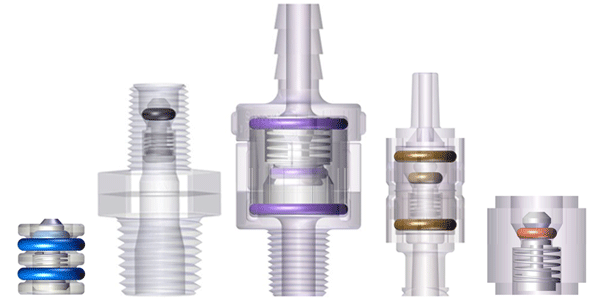
One of the most critical components of our custom check valves are o-rings. At Smart Products USA, we’ve spent over 40 years manufacturing check valves with o-rings in low-pressure, low-flow environments. From ongoing supply chain stability to their microscopic makeup, here are Frequently Asked Questions (FAQs) we often get about o-rings.
Q: What o-ring materials are available?
A: At Smart Products USA, we offer 7+ o-ring materials to include: Buna-N, EPDM (Ethylene-Propylene), Viton®, Silicone, Fluorosilicone, Aflas, and Kalrez®. For an overview of each material, please visit our o-ring materials page.
Q: How does Smart Products USA stay proactive amid o-ring supply chain challenges?
A: We recently posted, “The Valve O-Ring Supply Chain Is Fragile – What Can You Do?” in our blog to help customers better understand supply chain challenges. At Smart Products USA, it’s our job to stay aware of these challenges. We continuously monitor suppliers, vendors, and manufacturers, to ensure we can source quality o-rings for our valves.
Q: If an o-ring supplier changes or a specific o-ring is unavailable, what do we do?
A: First, we investigate how any changes may or may not affect original specifications. Next, we may contact our customers directly to come up with equivalent or alternative solutions prior to any assembly.
Q: How do you ensure o-ring inventory quality?
A: Our Quality Team scrutinizes the o-rings we receive, no matter how many years the supplier has been providing them to us. We have inspections and testing processes in place to ensure these components meet our high standards. To view our ISO 9001:2015 certificate, click here. Additionally, once assembled, we test 100% of all valves to ensure they seal.
Q: How do most customers choose o-rings to work for a specific application?
A: We can look at the o-ring’s viscosity, compression, options for curing, and more – all depending on a customer’s requirements. Options include:
- Washing o-rings twice to remove any debris
- Curing o-rings to affect their properties via various methods (i.e. sulfur, peroxide, etc.)
- Prescribing a soak test (if needed) to determine chemical compatibility
- Selecting o-ring materials and durometer (hardness of rubber), as well as spring force to be an ideal match for specific device requirements
- Adding an oil to prevent stiction
Q: What is the shelf-life of your valves’ o-ring seals?
A: While we can’t give a specific date for shelf-life, we do want to make customers aware of its importance. A long shelf-life, as well as storage temperatures, will affect a valve’s performance. For example, stiction is a natural occurrence also known as: the friction that tends to prevent stationary surfaces from being set in motion. If your valves are going to be stored or sitting idle for long periods of time, it’s important to know the rubber o-ring may begin sticking to the plastic o-ring seat or poppet. If you are concerned about stiction, we offer a Parylene coating process for o-rings which allows them to remain in a passive state longer. This coating can also prevent the risk of an elevated opening pressure. It’s important to note that the oil we use on o-rings during the assembly process does help mitigate stiction.
Need Help Choosing the Right Check Valve?
As a custom valve manufacturer, we recommend that you sample the valve that you are interested in and test it in your application. We can help you choose components (plastic body material, o-ring, spring pressure, and more) ideal for your device requirements.
For more information about how our valves work, visit our Check Valve Operation Page.
Additional questions about the o-rings we use?